CNN Kalshi Prediction Market: How Interactive Forecasting Is Changing the Way We Consume News
News has always been about what might happen next. Elections, economic decisions, court rulings, global conflicts — every major headline carries an element of uncertainty. But what if news coverage didn’t just tell you what experts think could happen, and instead showed you what thousands of people are actively betting on in real time?
That’s exactly what’s unfolding with the CNN Kalshi prediction market collaboration Kalshi’s official announcement. It’s a bold experiment that blends finance, technology, and journalism in a way mainstream media hasn’t tried before — and it could quietly reshape how the public understands future events.
Let’s break it down in simple terms and see why this matters far beyond one partnership.
What Is the CNN Kalshi Prediction Market?
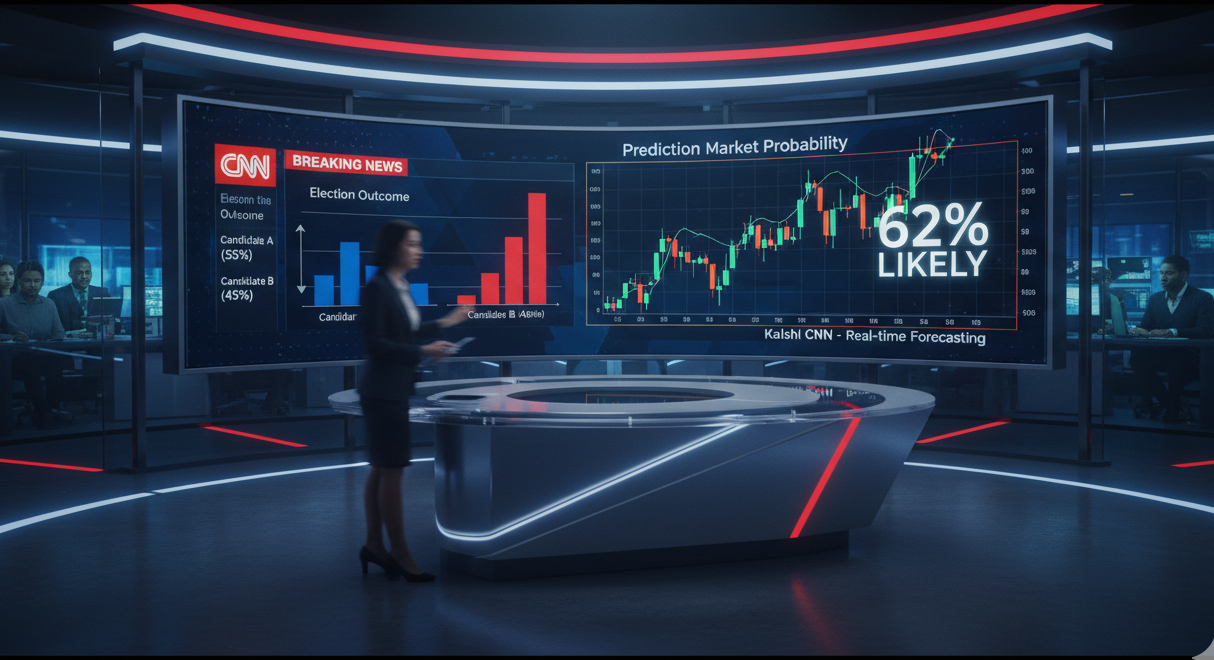
At its core, the CNN Kalshi prediction market brings real-time forecasting data into live news coverage.
Kalshi is a regulated prediction market platform where users trade on the outcomes of real-world events — not stocks or crypto tokens, but things like:
- Election outcomes
- Interest rate changes
- Economic indicators
- Major policy decisions
When CNN integrates this data into its reporting, viewers don’t just hear opinions or analysis. They see live probabilities derived from actual market behavior.
Think of it like this:
Traditional news coverage is similar to asking a panel of experts where they think the weather is headed. Prediction markets are more like looking at thousands of people who’ve put money down based on their forecasts.
Why Prediction Markets Are Different From Polls
Polls ask people what they believe. Prediction markets ask people what they believe enough to risk money on.
That difference is crucial.
In polls, honesty varies. Sometimes participants exaggerate. Sometimes they click random answers. Sometimes they respond based on emotion.
In prediction markets, bad guesses cost money.
This is why many economists and data scientists argue that markets often forecast outcomes more accurately than surveys. They combine information from countless sources into a single probability.
By featuring prediction market probabilities, CNN is essentially saying, “Here’s what collective intelligence believes right now.”
Why CNN Is Willing to Experiment With This
Legacy media is under pressure. Attention spans are shrinking, trust is fragile, and news consumers want transparency.
The CNN Kalshi prediction market experiment checks several strategic boxes:
- It’s interactive: Numbers change live, keeping viewers engaged.
- It’s data-driven: Less speculation, more measurable insight.
- It feels modern: Predictions backed by markets feel closer to finance and tech than traditional punditry.
CNN isn’t trying to push reporters out of the picture. The reporting still matters — the context, the questioning, the judgment. What changes is the toolbox. This adds another way to explain what’s happening and why people are reacting to it.
Let us take an example of election night. A candidate stumbles in a debate, or a surprise result that comes in from a swing state. Almost immediately, you will see the confidence rising or falling on screen, reflecting how thousands of people are adjusting their expectations in real time. It turns the broadcast into a living signal, not a static narrative.
A Simple Analogy That Makes It Click
Imagine planning a long road trip.
You could:
- Ask ten people what route they think is best, or
- Look at real-time traffic data from thousands of drivers already on the road
Traditional analysis is the first option. Prediction markets are the second.
Neither is perfect on its own. But together, they offer a clearer picture.
Why This Matters Beyond Media Headlines
At first glance, this might feel like just another media experiment. A TV network tries something new, people talk about it for a few days, and then the news cycle moves on. But this one runs deeper than that.
What’s really changing here is the relationship between information and decision-making. We’ve slowly shifted from relying on gut instinct and expert opinion to leaning on probabilities, projections, and live data. Investors already do this. Businesses do it too. Even everyday consumers check forecasts before making choices.
Now that same mindset is entering mainstream news.
When you show how expectations move in real time — after a policy speech, an economic report, or a major global event — you’re no longer just reporting what happened. You’re showing how confidence builds, cracks, or completely flips. That’s powerful because it helps people understand reaction, not just reaction headlines.
It also makes uncertainty easier to accept. Instead of pretending there’s always a clear answer, viewers see that outcomes live on a sliding scale. Nothing is fixed. Everything reacts. And that feels much closer to how the real world actually works.
This shift matters because once audiences get comfortable with probability-based thinking, it changes how they consume all information — not just news. They ask better questions. They look for signals, not soundbites. And over time, that can lead to more informed, less emotional conversations about complex issues.
The Regulatory Angle That Makes This a Big Deal
Prediction markets haven’t always operated in the open. Regulation has historically been a grey area.
Kalshi’s regulated status changes that conversation.
By partnering with a major network, the message is clear: prediction markets are no longer fringe tools used only by niche communities. They’re becoming legitimate sources of insight.
That legitimacy is key to broader adoption — especially among institutional audiences and everyday viewers who would never sign up for a trading platform themselves as this regulated exchange pushes boundaries in event forecasting.
How Interactive Forecasting Changes Viewer Behavior
Numbers change how people think.
When a news anchor says, “Experts believe outcome A is likely,” viewers react emotionally.
When a screen shows a live probability dropping from 62% to 55%, viewers start asking why.
That curiosity is powerful.
It encourages:
- Deeper engagement
- Critical thinking
- Less reliance on single narratives
Instead of passively consuming opinions, audiences begin tracking shifts, trends, and reactions in real time.
Potential Risks and Criticism Worth Acknowledging
Let’s be honest — this approach isn’t without controversy.
Critics raise valid concerns:
- Could prediction markets influence outcomes rather than reflect them?
- Will viewers confuse probabilities with certainties?
- Can markets be manipulated in high-stakes political moments?
These questions don’t make the idea flawed. They simply highlight the need for responsible implementation, clear labeling, and strong editorial context.
CNN’s role isn’t to blindly display numbers — it’s to explain them.
What This Signals for the Future of Journalism
The CNN Kalshi prediction market may be one of the earliest visible signs of a broader transformation.
Down the line, we could see:
- Economic forecasts tied to live trading sentiment
- Policy debates paired with probability shifts
- Global conflict coverage enriched by predictive analytics
This doesn’t eliminate journalism. It elevates it, adding evidence-based context to storytelling.
The future news consumer won’t just ask, “What happened?”
They’ll ask, “What’s most likely next — and why?”
Why This Trend Feels Inevitable
Whether we like it or not, modern audiences are drawn to measurable insights.
We already trust:
- Sports betting odds
- Market forecasts
- Weather probabilities
Applying the same logic to news events feels like a natural progression, not a disruption.
And once audiences experience coverage that evolves in real time, static analysis starts to feel outdated.
Final Takeaway for Readers
The CNN Kalshi prediction market is more than a partnership. It’s a signal.
A signal that journalism is embracing probability over speculation.
A signal that interactive, data-driven storytelling is becoming the new standard.
And a signal that future-facing media isn’t afraid to experiment.
What makes this interesting isn’t the tech itself — it’s the honesty. Not everything has a clear answer, and this approach doesn’t pretend otherwise. It simply shows the uncertainty as it exists.
Instead of someone telling you what to think, you get a front-row seat to how expectations are shifting moment by moment. You can agree, disagree, or just observe — but you’re no longer stuck with a single fixed narrative.
In a media landscape where everyone seems to have an opinion, that kind of openness might be the most useful thing news can offer right now.
Related Blogposts:
Want to see how AI is already redefining productivity and innovation? Check out our guide — Top 10 AI Tools for Productivity 2025